


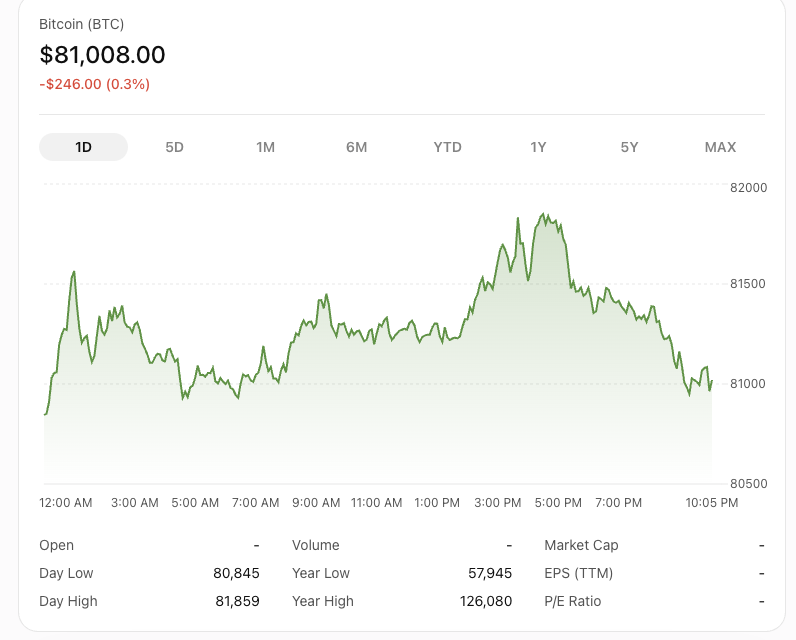
Bitcoin rebounds past $80K has become one of the biggest crypto market stories of September 2026, with the world’s largest cryptocurrency recovering rapidly after dropping into the mid-$75,000 range earlier in the week. Bitcoin climbed back through $78,000 and then reclaimed the psychologically important $80,000 level on September 18, with the rally continuing around the $81,000 region on September 19.
The move is particularly notable because it happened during a difficult macroeconomic environment. The Federal Reserve raised interest rates on September 16, inflation remains above the Fed’s target, global bond yields have been elevated, and U.S. crypto market-structure legislation suffered a setback in Congress. Normally, that combination could create substantial pressure on speculative assets.
Instead, Bitcoin recovered.
The rebound appears to be connected to several factors operating at the same time: new regulatory developments from the U.S. Securities and Exchange Commission and Commodity Futures Trading Commission, renewed institutional demand through spot Bitcoin exchange-traded funds, a large short squeeze, improving crypto sentiment and a market that had already absorbed much of the negative macroeconomic news.
At the time of research on September 19, 2026, Bitcoin was trading around the $81,000 area. CoinGecko data for September 19 showed Bitcoin’s market capitalization around $1.62 trillion and approximately $44.7 billion in reported trading volume. Its September 18 closing price was approximately $80,874.
For readers following Bitcoin through IBTC247, the important question is no longer simply whether BTC can trade above $80,000. The bigger issue is whether the latest rebound can develop into a sustainable breakout or whether $80,000-$86,000 will again become an area where sellers take control.
Bitcoin Reclaims $80,000 After Falling Toward $75,000
Bitcoin’s latest move has been unusually fast.
Earlier in September, BTC repeatedly struggled with the $80,000-$82,000 region. It traded above $81,000 on September 3 before moving lower and eventually reaching approximately $75,590 on September 15 according to CoinGecko’s historical data. It remained near $76,000 through September 16 and 17 before accelerating sharply higher.
On September 18, Bitcoin reclaimed $80,000 with a move of more than 5% during the session. The Block reported that the rally developed after BTC had spent recent weeks largely moving around the $75,000-$78,000 zone.
CoinDesk reported that Bitcoin climbed to around $81,000 later in the session, gaining close to 6% over 24 hours. Ether, XRP and Solana also advanced strongly, showing that the recovery was not limited to Bitcoin.
The speed of the rebound matters.
When an asset repeatedly tests resistance and then suddenly breaks through it, traders normally look at whether the move is supported by spot demand, ETF flows, trading volume and broader market participation. A move driven almost entirely by leverage can reverse quickly. A move accompanied by stronger spot and institutional demand can have more durable support.
In this case, evidence suggests that both genuine demand and forced derivatives buying contributed.
Why Did Bitcoin Rebound Past $80K?
There is no single explanation for Bitcoin’s September rebound.
Crypto markets rarely move because of one headline. Bitcoin was reacting simultaneously to U.S. regulatory policy, institutional capital flows, short liquidations, macroeconomic expectations and technical positioning.
One of the strongest catalysts came from changing expectations around U.S. digital-asset regulation.
The SEC announced an important “Innovation Exemption” on September 17. The action provides temporary and conditional regulatory relief intended to facilitate certain forms of on-chain trading involving tokenized U.S. securities.
SEC Chairman Paul Atkins described the measure as a bridge toward more permanent rulemaking. The SEC said the exemption provides temporary relief for qualifying Tokenized Securities Venues while imposing conditions involving transparency, recordkeeping and other safeguards.
The policy does not directly change Bitcoin’s protocol or Bitcoin ETF rules. However, markets can interpret regulatory developments more broadly.
If U.S. regulators create clearer pathways for blockchain-based financial infrastructure, investors may view the overall regulatory environment for digital assets as becoming more predictable. That can reduce one category of uncertainty that has historically affected crypto valuations.
SEC Innovation Exemption Becomes an Important Market Catalyst
The SEC’s September 17 announcement came at an important moment.
Earlier in the week, attempts to advance the CLARITY Act had run into difficulty. The legislation has been closely watched because the U.S. crypto industry has sought clearer divisions of responsibility between securities and commodities regulators.
The failure to advance legislation initially contributed to weaker crypto sentiment.
But the SEC’s subsequent regulatory action demonstrated that federal agencies could continue developing digital-asset policy even while broader legislation remained unresolved.
SEC Chairman Atkins said on September 17 that the agency was moving forward within its existing statutory authority following the legislative setback. The initiative allows experimentation involving certain tokenized securities while the SEC continues considering longer-term rules.
This distinction is important.
The SEC action should not be interpreted as complete regulatory certainty for the U.S. crypto market. It is temporary, conditional and limited in scope.
However, from a market perspective, traders appeared to treat the decision as evidence that the regulatory process had not stopped.
That change in sentiment helped crypto markets look beyond the negative legislative headlines.
CFTC Sends Major Crypto Rulemaking for White House Review
The SEC was not the only U.S. regulator moving forward.
Another potentially important development emerged from the Commodity Futures Trading Commission.
A CFTC regulatory proposal titled “Regulation Crypto Asset Transactions and Regulation Crypto Asset Markets” was submitted for review on September 17.
The U.S. Office of Information and Regulatory Affairs listed the proposal under RIN 3038-AF80 and showed its status as “Pending Review” on September 19. The submission represents an early stage of the regulatory process; detailed final rules have not yet been published.
That limitation matters.
The existence of the submission does not mean that a new regulatory framework has already taken effect.
Nevertheless, the market responded positively to evidence that the CFTC was moving ahead with crypto market rulemaking.
The Block reported that Bitcoin’s return above $80,000 came as both the SEC and CFTC advanced regulatory initiatives despite the congressional setback.
For Bitcoin investors, this creates an important policy theme: regulatory clarity may increasingly come from several directions rather than from one comprehensive piece of legislation.
U.S. Crypto Regulation Is Moving on Multiple Tracks
The latest developments are part of a broader regulatory shift that has been developing throughout 2026.
On August 18, the SEC proposed Regulation Crypto Assets, a framework designed to create a tailored offering regime for certain investment contracts involving crypto assets.
The proposal contains two potential registration exemptions. One could apply to offerings of up to $5 million during a four-year period, while another could apply to offerings of up to $75 million during a 12-month period. The proposal also includes a conditional safe-harbor framework. Public comments are due October 20, 2026.
Earlier, on March 17, the SEC issued an interpretation addressing how federal securities laws apply to various crypto assets and crypto-related transactions. The interpretation became effective on March 23.
These measures do not eliminate legal uncertainty from cryptocurrency markets.
But they show that U.S. digital-asset policy in 2026 is increasingly moving from enforcement-focused uncertainty toward detailed regulatory frameworks, interpretations, exemptions and formal rulemaking.
That development may help explain why traders reacted positively to September’s agency actions even after the CLARITY Act experienced difficulties.
The Federal Reserve Just Raised Interest Rates
Bitcoin’s rebound becomes more interesting when viewed against monetary policy.
On September 16, 2026, the Federal Reserve increased the federal funds target range by 25 basis points to 3.75%-4.00%.
The FOMC said economic activity continued expanding at a solid pace but inflation remained elevated. The vote was unanimous.
Higher interest rates are normally a potential negative factor for Bitcoin and other risk assets.
When Treasury securities and other relatively low-risk investments offer higher yields, investors may demand greater compensation for holding volatile assets. Higher rates can also strengthen the dollar and increase borrowing costs across the economy.
Bitcoin initially struggled around the Fed decision but did not experience the prolonged decline some traders expected.
By September 18, BTC had recovered above $80,000.
This suggests that at least part of the monetary-policy risk had already been priced into the market before the actual announcement.
Inflation Remains a Risk for Bitcoin
The Fed’s rate increase also needs to be understood in the context of inflation.
The U.S. Bureau of Labor Statistics reported on September 11 that the Consumer Price Index increased 0.4% in August on a seasonally adjusted basis.
Headline CPI was 3.4% higher than one year earlier, while core CPI excluding food and energy increased 2.4% year over year.
Producer prices have also remained elevated. The Producer Price Index for final demand increased 0.4% in August and was 5.4% higher over the previous 12 months.
This remains one of the largest risks to the Bitcoin rally.
If inflation continues accelerating, markets could begin pricing additional monetary tightening. Higher expected rates could raise Treasury yields, strengthen the dollar and reduce liquidity available for speculative assets.
Bitcoin’s September recovery therefore should not be interpreted as proof that macroeconomic conditions no longer matter.
Instead, the latest price action shows that positive crypto-specific developments can temporarily outweigh negative macro factors.
Bitcoin Shows Unusual Strength Against Rising Bond Yields
Another notable part of the September 18 rally was Bitcoin’s relative strength compared with traditional markets.
During the session, CoinDesk reported that Bitcoin moved above $80,000 while major U.S. stock indexes were trading lower. The U.S. 10-year Treasury yield had also moved back above 5%, while the U.S. Dollar Index approached 100.5.
Historically, rising real yields and a stronger dollar can create difficult conditions for Bitcoin.
That relationship is not permanent, however.
Bitcoin sometimes trades as a high-beta technology-like risk asset, but at other times crypto-specific capital flows dominate. Regulatory developments, ETF demand, leverage positioning and investor allocation decisions can temporarily become more important than traditional cross-asset correlations.
The September 18 session appears to have been one of those periods.
Traders should nevertheless be cautious about assuming that Bitcoin has permanently decoupled from interest rates.
If bond yields remain elevated for an extended period, financing conditions could eventually affect crypto liquidity.
Spot Bitcoin ETF Demand Returns
Institutional demand through U.S. spot Bitcoin ETFs provides another important part of the picture.
ETF flows had been volatile heading into the rebound.
Large withdrawals occurred earlier in the week before demand returned strongly toward the end of the period.
The Block reported on September 19 that U.S. spot Bitcoin ETFs received approximately $433 million in net inflows on Friday, September 18, according to its analysis of SoSoValue data.
That was enough to leave the entire week ending September 18 with approximately $6.2 million in net inflows, despite substantial withdrawals earlier in the week. Fidelity’s FBTC reportedly accounted for about $310.7 million of Friday’s inflows.
This is important because ETF activity provides one way to evaluate institutional demand separately from highly leveraged derivatives trading.
A single strong day does not establish a long-term trend.
However, renewed inflows arriving as BTC returned above $80,000 suggest that institutional demand was participating in the rebound rather than simply watching from the sidelines.
ETF Flows Remain Volatile
The positive Friday ETF number should not be interpreted without context.
Bitcoin ETF flows have been extremely inconsistent through September.
Farside Investors recorded substantial daily inflows earlier in the month but also large outflow sessions around the Federal Reserve meeting.
This means investors should focus on multi-week trends rather than reacting to a single day’s number.
Sustained ETF inflows would provide stronger evidence that institutions are accumulating Bitcoin above $80,000.
Repeated outflows, particularly while BTC tests resistance, would create a more cautious signal.
For the next stage of Bitcoin’s trend, ETF flows are likely to remain one of the most useful indicators to follow.
Short Squeeze Accelerates the Bitcoin Rally
The rebound was also amplified by derivatives positioning.
CoinDesk reported that approximately $470 million in crypto short positions were liquidated over a 24-hour period as the market rallied on September 18.
Bitcoin represented the largest portion, with approximately $238 million of BTC shorts liquidated as the price approached $81,000.
This creates a short squeeze.
When traders borrow or use leverage to bet that Bitcoin will fall, their positions may be automatically closed when the market moves far enough against them. Closing a short normally requires buying the underlying exposure back.
When thousands of leveraged traders are forced to buy simultaneously, that activity can accelerate an already rising market.
This helps explain why Bitcoin moved so rapidly from the upper-$70,000s through $80,000.
But it creates an important distinction.
Short-covering can increase momentum without necessarily representing new long-term investment demand.
The strongest bullish scenario would therefore involve continued spot and ETF demand after the short squeeze fades.
Bitcoin Trading Volume Increases With the Breakout
Trading activity also expanded as Bitcoin moved higher.
CoinGecko listed approximately $44.7 billion in Bitcoin trading volume for September 19 compared with roughly $23.6 billion on September 18 in its historical dataset snapshot. Bitcoin’s market capitalization stood around $1.62 trillion.
Higher volume during a breakout can make the move more significant because it indicates greater participation.
However, traders still need to examine where the volume originates.
Spot buying, ETF creation, perpetual futures activity and forced liquidations have different implications.
A sustainable move generally benefits from real spot-market demand continuing after leverage-driven volatility cools.
Bitcoin Faces Major Resistance Around $81K-$86K
Reclaiming $80,000 does not mean Bitcoin has cleared every important technical barrier.
The region immediately above the current market contains several resistance levels that analysts have been monitoring.
On September 12, CryptoQuant told The Block that Bitcoin needed to clear approximately $81,700 to strengthen the case for a new bull-market phase. It identified further resistance near $83,600 and $88,700.
Glassnode previously identified the broader $81,000-$86,000 range as an important supply zone because many longer-term holders and self-custody investors have cost bases in that area.
These levels should be treated as analytical reference points rather than guaranteed turning points.
Markets do not have to reverse at a specific number.
Still, the concentration of historical supply means the $81,000-$86,000 region could become a major test of whether the September rebound has enough demand behind it.
Why $80,000 Matters Psychologically
Round numbers matter in financial markets because traders pay attention to them.
Bitcoin at $80,000 does not become fundamentally different from Bitcoin at $79,900. But the level can still influence positioning.
Large round numbers commonly attract limit orders, options positioning, media attention and retail interest.
Bitcoin has also spent much of the recent period repeatedly trading around the $75,000-$82,000 area.
That makes $80,000 more than just a psychological number. It has also become part of the current market structure.
If Bitcoin can remain above $80,000 while repeatedly absorbing selling pressure, traders may begin treating the level as support.
If BTC quickly falls back below it, the latest breakout could instead be interpreted as another unsuccessful attempt to escape the established range.
Key Bitcoin Support Levels to Watch
The first important level is the breakout region around $80,000.
A short-term pullback that holds near $80,000 would suggest buyers are willing to defend the former resistance area.
Below that, the $77,000-$78,000 region deserves attention because it acted as an important trading zone earlier in September.
The Block reported on September 7 that analysts were watching approximately $77,000-$78,000 as support while $80,000-$82,000 represented resistance.
The next important area is around $75,000-$76,000, where Bitcoin repeatedly found buyers during its mid-September weakness.
A sustained move below that zone would weaken the immediate bullish structure and suggest that the breakout above $80,000 had failed.
Technical levels should never be viewed in isolation. ETF flows, macro conditions, spot volume and derivatives leverage should be evaluated alongside price.
Bitcoin On-Chain Data Had Been Improving Before the Rally
On-chain information provides another perspective.
Before the latest breakout, CryptoQuant data cited by The Block showed Bitcoin’s 30-day realized-cap change turning positive on August 24 after 87 days in negative territory.
By September 6, the measure had reached approximately 0.88%, while realized capitalization increased by about $9.36 billion over 30 days to roughly $1.068 trillion.
Realized capitalization values Bitcoin based on the price at which coins last moved rather than using the current market price for the entire circulating supply.
When realized cap increases, it can indicate that capital is entering the network and coins are changing hands at higher valuations.
It does not guarantee higher prices.
But combined with ETF demand and stronger spot trading, improving realized capitalization can provide evidence that the market recovery is broader than one short-lived derivatives event.
Altcoins Rally Alongside Bitcoin
Bitcoin was not the only cryptocurrency to benefit from the changing market environment.
CoinDesk reported on September 18 that Ether gained approximately 7.3%, XRP advanced around 8.9%, and Solana rose approximately 12.7% during the broader crypto rally.
Solana’s move was particularly strong, with SOL reaching around $112 during the session, its highest level in seven months according to CoinDesk’s reporting.
Several Solana DeFi tokens also moved higher.
This matters because broad market participation can signal stronger risk appetite.
When Bitcoin rises while nearly every altcoin continues falling, the market may still be defensive.
When Bitcoin, Ether, large-cap altcoins and DeFi assets rise together, capital is usually spreading further along the risk curve.
That said, altcoins generally remain more volatile than Bitcoin. Strong altcoin performance during a rally can reverse much more quickly if BTC loses momentum.
DeFi Benefits From Improving Risk Sentiment
The rebound also extended into decentralized finance.
Solana-based projects such as Jupiter, Raydium and Meteora recorded strong gains during the September 18 rally, according to CoinDesk.
The connection between Bitcoin and DeFi is indirect but important.
Bitcoin frequently acts as the primary liquidity and sentiment benchmark for the cryptocurrency market.
When BTC stabilizes and investors become more comfortable taking risk, capital can move into Ether, Solana, decentralized exchanges, lending protocols and smaller tokens.
This process can create an environment commonly described as capital rotation.
However, traders should not automatically interpret one strong day as the beginning of a broad altcoin season.
A sustained shift would require continuing relative strength, increasing liquidity and broader participation over a longer period.
The Bullish Case for Bitcoin
Several factors currently support a constructive Bitcoin outlook.
First, Bitcoin recovered above $80,000 despite substantial macroeconomic pressure.
Second, the SEC and CFTC are actively developing new regulatory frameworks and exemptions for digital assets and blockchain-based markets.
Third, Bitcoin ETF demand returned strongly at the end of the week.
Fourth, on-chain realized capitalization had already begun improving before the latest move.
Fifth, the rally expanded beyond Bitcoin into Ether, Solana and other large crypto assets.
Finally, the market was able to absorb a Federal Reserve rate increase without entering another major selloff.
Together, these factors indicate that buyer demand remains meaningful.
They do not prove that Bitcoin will continue rising, but they make the September recovery more important than a normal intraday bounce.
The Bearish Case and Major Risks
There are equally important reasons to remain cautious.
The first is monetary policy.
The Federal Reserve has just raised rates to 3.75%-4.00%, while U.S. headline inflation remains 3.4%. If inflation remains persistent, further tightening could become a headwind for Bitcoin.
The second risk is resistance.
Bitcoin is entering an area around $81,000-$86,000 where analysts have previously identified significant supply.
Third, a large part of the immediate rally was accelerated by short liquidations. Once forced buying disappears, Bitcoin will need organic demand to continue advancing.
Fourth, ETF flows remain volatile rather than consistently positive.
Fifth, U.S. crypto legislation remains unresolved. Regulatory agencies are moving forward, but congressional uncertainty has not disappeared.
Finally, geopolitical developments, oil prices, bond yields and dollar strength remain important macro risks.
The market therefore has both genuine bullish catalysts and significant reasons for caution.
Is Bitcoin Above $80K a Confirmed Breakout?
It is still too early to describe the move as a fully confirmed long-term breakout.
Bitcoin has reclaimed the level, but confirmation normally requires more than briefly trading above resistance.
Traders will watch whether BTC can maintain daily closes above $80,000, absorb supply around $81,000-$86,000 and continue attracting spot demand.
A move through $81,700 and then $83,600 would clear reference resistance levels identified by CryptoQuant earlier in September.
Beyond that, the market would face the broader $86,000 area before approaching higher resistance.
The key concept is acceptance.
If the market spends increasing time above $80,000 without heavy selling, the probability of $80,000 becoming support improves.
If Bitcoin rapidly returns to $75,000-$78,000, the breakout becomes less convincing.
What Traders Should Watch Next
Bitcoin traders should monitor several categories of information rather than focusing only on price.
ETF flows will show whether institutional investors continue adding Bitcoin exposure after the breakout.
Spot trading volume can indicate whether genuine buying remains strong after the short squeeze.
Funding rates and open interest can reveal whether leverage is rebuilding too quickly.
The $81,000-$86,000 area will show whether sellers continue defending the major supply zone.
Federal Reserve communication matters because additional rate expectations can influence Treasury yields, dollar liquidity and risk appetite.
Inflation data remains important because persistent inflation could force monetary policy to remain restrictive.
SEC and CFTC rulemaking should also be followed closely. The regulatory proposals now moving through the system are not final, and future details may change how markets interpret them.
IBTC247 readers following the Bitcoin market should therefore treat the $80,000 recovery as an important development, but not as a reason to ignore risk.
Could Policy Become a Larger Bitcoin Catalyst in Late 2026?
Regulation could remain one of the dominant crypto themes through the remainder of 2026.
For years, one of the industry’s largest concerns has been uncertainty regarding how U.S. securities and commodities laws apply to digital assets.
That uncertainty has not disappeared.
However, the SEC’s March interpretation, its August Regulation Crypto Assets proposal, the September Innovation Exemption and the CFTC’s latest submission show that agencies are attempting to construct more detailed frameworks.
Markets generally prefer rules they can evaluate to uncertainty they cannot price.
If regulatory frameworks become clearer without severely limiting market access, institutional participation could benefit.
If upcoming rules impose unexpected restrictions or congressional disagreements deepen, sentiment could move in the opposite direction.
Policy is therefore a catalyst and a risk at the same time.
Bitcoin Market Outlook After the $80K Recovery
Bitcoin enters the second half of September with stronger momentum than it had only a few days earlier.
BTC has recovered from approximately $75,000-$76,000 to above $80,000, institutional ETF demand improved at the end of the week, regulatory announcements strengthened sentiment and short sellers were forced to cover positions.
But Bitcoin has not yet escaped every challenge.
The $81,000-$86,000 region remains technically important. Monetary conditions are restrictive. Inflation remains elevated. ETF flows have been inconsistent. And congressional crypto legislation remains uncertain.
This creates a market where confirmation is more important than excitement.
If Bitcoin establishes support above $80,000 and continues attracting spot and institutional demand, the September rebound could become a more meaningful structural move.
If momentum weakens near resistance and BTC returns below $78,000-$80,000, the market could remain trapped inside the broader range that has dominated recent trading.
Conclusion: What Bitcoin Investors Should Watch Next
Bitcoin’s rebound past $80K is significant because it happened while the market was confronting several major headwinds at once.
The Federal Reserve raised interest rates on September 16. Inflation remains above target. Treasury yields remain high. U.S. crypto legislation suffered a setback.
Yet Bitcoin recovered.
Fresh policy actions from the SEC and CFTC changed the regulatory narrative, U.S. spot Bitcoin ETF demand improved sharply at the end of the week, on-chain indicators had been strengthening, and a major short squeeze accelerated the move through $80,000.
The next phase is likely to be more important than the initial breakout.
Traders should watch whether Bitcoin can hold $80,000 as support, clear the $81,000-$86,000 supply region, maintain healthy trading volume and attract continuing ETF inflows without excessive leverage.
They should also follow Federal Reserve policy, inflation, Treasury yields and the next stages of SEC and CFTC rulemaking.
Bitcoin has regained momentum, but a move above a major round number does not guarantee a new sustained bull trend. The strongest confirmation would come from continued demand, improving market structure and the ability to withstand future macroeconomic pressure.
For now, Bitcoin’s return above $80,000 shows that the crypto market remains highly responsive to regulatory progress and institutional capital even during a challenging interest-rate environment.
Frequently Asked Questions
Why did Bitcoin rebound above $80,000?
Bitcoin’s rebound was supported by several factors, including new SEC and CFTC regulatory developments, renewed spot Bitcoin ETF demand, improving market sentiment and a significant short squeeze that forced bearish traders to buy back positions.
What was Bitcoin trading at on September 19, 2026?
Bitcoin was trading around the $81,000 area during research for this article on September 19, although crypto prices change continuously. CoinGecko and CoinMarketCap data both showed BTC around this general level.
What is Bitcoin’s main resistance after $80,000?
Analysts have identified resistance around $81,700, $83,600 and the wider $81,000-$86,000 region. These are analytical reference points rather than guaranteed reversal levels.
What is the SEC Innovation Exemption?
The SEC’s September 17 Innovation Exemption provides temporary, conditional regulatory relief intended to facilitate certain forms of on-chain trading involving tokenized securities while maintaining requirements such as transparency and recordkeeping.
What is the CFTC’s new crypto proposal?
A proposal called “Regulation Crypto Asset Transactions and Regulation Crypto Asset Markets” was submitted for White House regulatory review on September 17. As of September 19, it remained pending review, and detailed final rules had not taken effect.
Are Bitcoin ETFs buying again?
ETF demand strengthened at the end of the week. The Block reported approximately $433 million in net U.S. spot Bitcoin ETF inflows on September 18, leaving the full week slightly positive.
Did the Federal Reserve raise interest rates?
Yes. On September 16, 2026, the Federal Reserve increased its target range by 25 basis points to 3.75%-4.00%.
Is Bitcoin now in a confirmed bull market?
The rebound is constructive, but one move above $80,000 does not confirm a sustained bull trend. Traders are watching whether BTC can remain above the breakout level and overcome resistance in the $81,000-$86,000 area.
Suggested Tags
Bitcoin, Bitcoin Price, BTC, Bitcoin News, Crypto News, Bitcoin ETF, Crypto Regulation, SEC Crypto, CFTC Crypto, Bitcoin Trading, Crypto Market, Bitcoin Analysis
Internal Link Suggestions
Bitcoin News — Link to IBTC247’s Bitcoin category for ongoing BTC price and market coverage.
Crypto News — Link regulatory and macroeconomic references to the main IBTC247 Crypto News section.
Bitcoin ETF Guide — Link to an IBTC247 explainer covering spot Bitcoin ETFs, inflows, outflows and institutional demand.
Crypto Trading Guide — Link technical sections such as support, resistance, volume and market structure to the Trading category.
U.S. Crypto Regulation Guide — Link SEC, CFTC and market-structure references to a dedicated IBTC247 regulatory explainer.
Disclaimer: “This article is for informational and educational purposes only and does not constitute financial or investment advice.”
