


You have probably seen two versions of the same coin listed on a decentralized exchange — the “real” token on its home blockchain, and a wrapped version of it living on another chain. If that feels confusing, you are not alone. The difference between wrapped tokens and native tokens trips up beginners constantly, and misunderstanding it can cost you money if you pick the wrong one.
In this guide, you will learn what native tokens are, what wrapped tokens are, how the wrapping process works in plain terms, the key differences between the two, and the honest risks that come with wrapped versions — including custodian risk, depeg risk, and smart-contract risk. By the end, you will know exactly which one to use in common situations and how to avoid the scams that target confused newcomers.
id=”what-are-native-tokens”>What Are Native Tokens?
A native token is the original asset that lives on its home blockchain. Bitcoin (BTC) is native to the Bitcoin blockchain. Ether (ETH) is native to Ethereum. Solana’s SOL is native to Solana. These tokens were created by their chain’s own protocol rules, they are secured by that chain’s own validators or miners, and they do not depend on any outside party to hold their value.
Native tokens usually serve a practical purpose on their chain: they pay transaction fees, they are used for staking on proof-of-stake chains, and they often act as the main unit of value that everything else is priced against. When you hold native BTC in a Bitcoin wallet, what you own is straightforward — coins recorded on the Bitcoin ledger, controlled by your private keys, with no intermediary involved in the fact that those coins exist.
The defining feature of a native token is independence. It does not rely on a custodian holding a reserve somewhere else. It does not rely on a smart contract on a different chain staying healthy. Its existence and its supply are governed by the rules of its own network. If you can verify the chain itself — which block explorers let you do — you can verify the token. This independence is also why native tokens are generally considered the “cleanest” form of an asset: there is one less layer of trust between you and your money.
That said, native tokens have a limitation that matters for this whole discussion: they are stuck on their home chain. Bitcoin cannot natively move to Ethereum. ETH cannot natively move to Solana. Blockchains are separate systems that do not understand each other by default. A Bitcoin wallet has no idea what an Ethereum smart contract is. This is the problem that wrapped tokens were invented to solve.
What Are Wrapped Tokens?
A wrapped token is a representation of a native token that lives on a different blockchain. The most famous example is Wrapped Bitcoin (WBTC), an ERC-20 token on Ethereum that is designed to track the value of Bitcoin. One WBTC is meant to be redeemable for one BTC. It lets Bitcoin holders participate in Ethereum’s ecosystem — lending protocols, decentralized exchanges, and DeFi apps — without selling their Bitcoin.
The word “wrapped” is a metaphor. Think of it like a coat-check ticket. You hand over your real coat (the native token) at the counter, and you get a ticket (the wrapped token) that represents your claim on that coat. You can trade the ticket, lend it out, or use it in DeFi apps. When you want your actual coat back, you return the ticket and the counter hands you the original. The ticket itself is only valuable because someone trustworthy is standing behind the counter holding the real coats.
Wrapped tokens exist for many assets, not just Bitcoin. There are wrapped versions of Ether on other chains, wrapped versions of BNB, wrapped stablecoins, and more. Some are created through custodial systems where a company or consortium holds the native tokens in reserve. Others are created through decentralized bridge protocols that lock native tokens in smart contracts. The mechanics differ, but the core idea is always the same: a token on chain B that represents an asset that actually lives on chain A.
Here is the critical point that beginners often miss: a wrapped token is an IOU. It is a claim on the underlying asset, not the underlying asset itself. Its value depends entirely on the reliability of the wrapping system — the custodian holding the reserves, or the smart contract locking them. If that system fails, is hacked, or turns out to be dishonest, the wrapped token can lose its peg to the native asset. When you hold WBTC, you hold a promise that one WBTC equals one BTC. A promise is not the same thing as the thing itself.
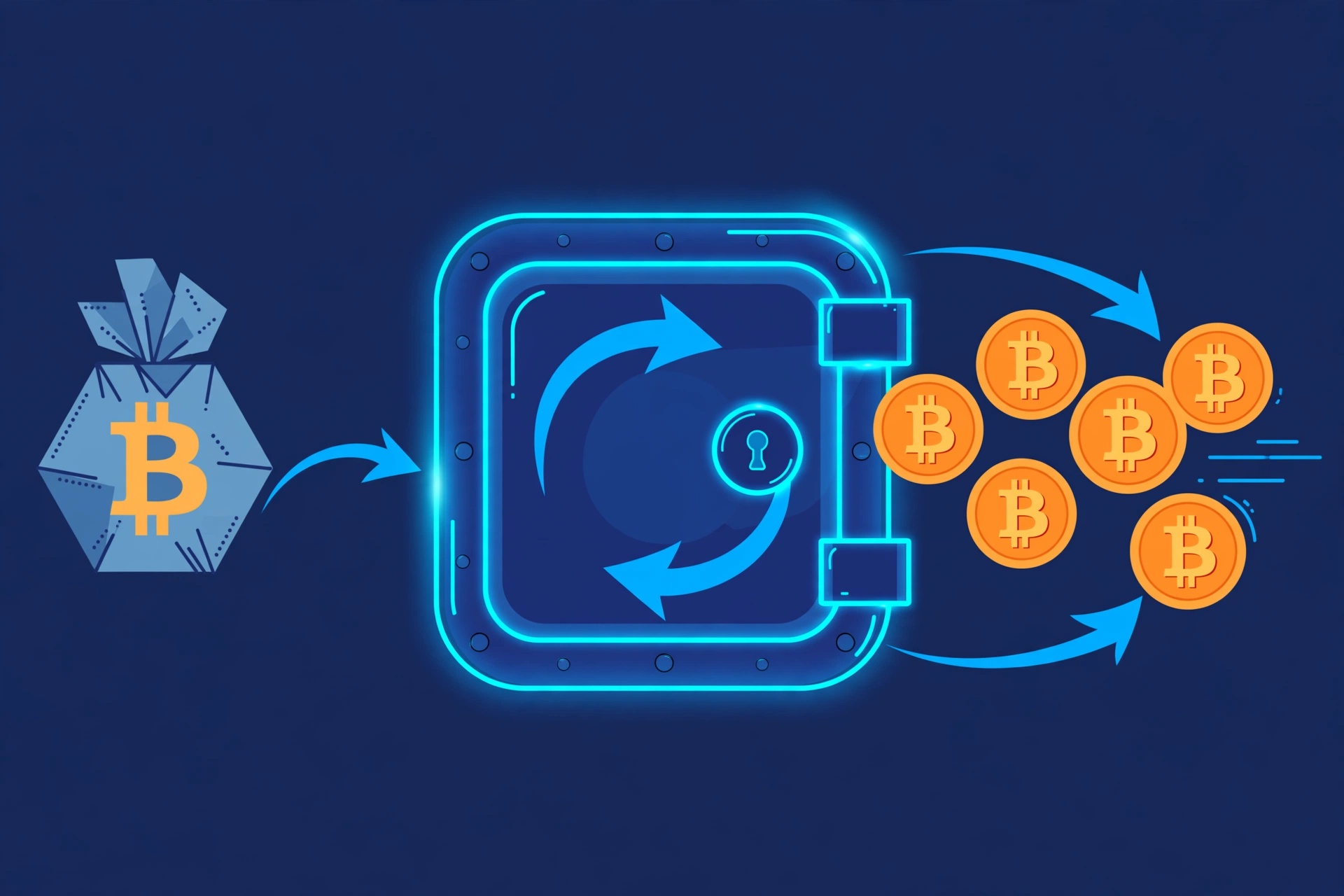
How Wrapping Works (The General Process)
Wrapping follows the same basic pattern no matter which token or chain is involved. Understanding this pattern helps you evaluate any wrapped token you encounter, because the pattern is where the risks live.
Step one: you deposit the native token. You send your native tokens to a designated address controlled by the wrapping system. This might be a wallet controlled by a custodian company, or it might be a smart contract on the native chain. Either way, your original tokens are now locked up and you cannot spend them directly.
Step two: the system verifies the deposit. The wrapping system confirms that your tokens arrived. In custodial systems, the custodian’s own processes verify this. In decentralized systems, validators or a smart contract observe the deposit transaction on the native chain. This verification step takes time — it is one reason wrapping and unwrapping are not instant.
Step three: wrapped tokens are minted on the target chain. Once the deposit is confirmed, the system creates (mints) an equivalent amount of wrapped tokens on the destination chain and sends them to your address there. If you deposited one BTC, you receive one WBTC on Ethereum. The total supply of the wrapped token is supposed to always match the total amount of native tokens held in reserve.
Unwrapping reverses the process. When you want your native tokens back, you send the wrapped tokens to the wrapping system, which destroys (burns) them and releases the equivalent native tokens from the reserve back to you. Burning matters because it keeps the supply honest: wrapped tokens only exist while the matching native tokens are locked up.
The whole system rests on one requirement: reserves must actually exist and must stay equal to the wrapped supply. Honest wrapping systems publish proof of reserves — ways for the public to check that the custodian wallets or lock-up contracts really hold the backing assets. A wrapped token whose reserves you cannot verify is a wrapped token you should not trust. This verification step is not optional homework; it is the core of the entire arrangement.
Native vs Wrapped: The Key Differences
Now that you understand both concepts, here is how they compare across the factors that actually matter to you as a holder.
| Factor | Native token | Wrapped token |
|---|---|---|
| What it is | The original asset on its home chain | A representation of that asset on another chain |
| Backing | Secured by its own blockchain’s rules | Backed by locked reserves held by a custodian or contract |
| Trust required | Trust in the blockchain itself | Trust in the blockchain plus the wrapping system |
| Where it works | Only its home chain (and apps built on it) | The destination chain and its DeFi ecosystem |
| Peg risk | None — it is the reference asset | Can depeg if reserves fail or the system is exploited |
| Redeemability | Always spendable on its chain | Redeemable only if the wrapping system honors redemptions |
| Typical use | Holding, paying fees, staking on the home chain | Using the asset inside another chain’s DeFi apps |
| Failure modes | Chain-level problems (extremely rare) | Custodian failure, smart-contract bugs, bridge hacks |
The table makes the central trade-off visible: wrapped tokens buy you utility — access to DeFi ecosystems your native token cannot reach — and they charge you for it in trust. Every wrapped token adds a layer between you and your asset. Layers can fail. That does not make wrapped tokens bad; it makes them a tool with a cost, and you should only pay that cost when the utility is worth it.
One difference deserves emphasis because it surprises people: wrapped tokens can trade at a different price than the native token. Normally the difference is tiny because arbitrage traders buy the cheaper one and redeem or sell it, which pushes prices back together. But during crises — a custodian rumored to be insolvent, a bridge exploit in progress — the wrapped token can trade at a steep discount while everyone rushes to unwrap. If you are holding the wrapped token when that happens, you feel the loss. The native token holders, sitting on their home chain, are unaffected.
The Honest Risks of Wrapped Tokens
Wrapped tokens are useful, but you should go in with your eyes open. These are the main risks, described honestly.
Custodian risk. In custodial wrapping systems, a company or small group holds the native tokens that back the wrapped supply. You are trusting that custodian to keep the reserves intact, not lend them out recklessly, not get hacked, and not disappear. History has shown that custodians — even large, reputable-looking ones — can fail. When evaluating a wrapped token, ask who holds the reserves and what evidence of those reserves is published. If the answer is vague, treat the token accordingly.
Depeg risk. A wrapped token is supposed to trade 1:1 with its native asset, but that peg is a market outcome, not a law of physics. If confidence in the backing breaks — because of a hack, a custodian problem, or even a convincing rumor — holders rush to unwrap or sell, and the wrapped token can trade well below the native asset’s price. Unlike a stablecoin depeg, which at least has a redemption mechanism through an issuer, a wrapped token in a broken system may have no working exit at all.
Smart-contract risk. Decentralized wrapping systems lock reserves in smart contracts instead of custodial wallets. Smart contracts are code, and code has bugs. Bridge and wrapping contracts are among the most attacked code in crypto precisely because they hold enormous reserves. A single exploited contract can drain the backing for a wrapped token, leaving holders with tokens backed by nothing.
Redemption risk. Even in a healthy system, unwrapping is not always instant or cheap. There can be waiting periods, minimum amounts, fees, or know-your-customer steps depending on the system. In a stressed system, redemptions can be paused entirely. Never assume you can unwrap at full value on demand, especially during a crisis — that is exactly when exits tend to close.
Chain risk stacking. A wrapped token inherits the risks of both chains: the native chain where the reserves live and the destination chain where the wrapped token circulates. Problems on either chain — congestion, outages, reorganizations — can affect your wrapped position. Native holders only worry about one chain.
When to Use Which One
So which should you actually use? It depends on what you are trying to do.
Use the native token when: you are simply holding the asset long-term, paying transaction fees on its home chain, or staking it on its native network. For storage and for the chain’s core functions, native is the cleaner, lower-trust option. If you do not need the asset to leave its home chain, there is no reason to wrap it.
Use the wrapped token when: you specifically need the asset inside another chain’s ecosystem — for example, using Bitcoin as collateral in an Ethereum lending app, or providing it as liquidity on a decentralized exchange that does not support the Bitcoin chain. Our Wrapped BTC vs Native BTC comparison walks through that exact decision for Bitcoin holders. In these cases the wrapped token is the tool that makes the strategy possible. Just go in knowing the trade-offs: keep positions sized so that a depeg would hurt but not ruin you, prefer wrapped tokens with transparent, verifiable reserves, and have an exit plan that does not assume instant unwrapping.
Avoid wrapping when: the wrapped version comes from an issuer you cannot verify, the reserves are not publicly auditable, or you are being rushed into it by someone else’s instructions. Those are the situations where the extra trust layer is most likely to fail you. Also avoid holding large amounts of wrapped tokens idly when you have no active use for them on the destination chain — unwrapping back to native removes a layer of risk for free.
One more practical habit: when you first use a wrapped token, test with a small amount. Wrap a little, unwrap it back, and confirm the full round trip works and the fees are what you expected. A cheap test beats an expensive lesson.
Frequently Asked Questions

The Bottom Line
Native tokens are the original asset on their home chain — independent, simple, and trust-minimized. Wrapped tokens are IOUs that let that asset travel to other chains and participate in their DeFi ecosystems, at the cost of extra trust in custodians or smart contracts. Neither is universally better; the right choice depends on what you are doing. Hold native when you do not need to leave the home chain, use wrapped when you need cross-chain utility, and always verify reserves and contract addresses before trusting a wrapped token with real money.
This guide is for education only — not financial advice.
